The argument
Abstract
A trading pair expresses two exposures, but launch design has largely concentrated on the token being issued. Lots makes the other side of the pair composable. A fixed Lot packages specified quantities of eligible component tokens into one redeemable asset that multiple launch markets can share. LotFlow connects that asset to component-market liquidity through minting and redemption, while each launch retains its own price, trading fee and locked liquidity. This paper explains the architecture, the arithmetic of fixed recipes, the conditions required for execution, and the distinction between market activity and proposed protocol-token rewards. The result is a model for narrative markets in which the quote asset carries an explicit asset thesis. It also creates dependencies: component liquidity, issuer controls, price checks and settlement inventory remain essential, and a launch token never inherits the Lot’s redemption rights.
Edition 1.0 describes the fixed-Lot architecture, v1.6 launch terms and current LotFlow design documented at the editorial cutoff. Application access remains restricted. Protocol $LOTS buybacks, holder distributions, Dynamic Lots and SocialFi creator markets are upcoming. Numerical scenarios are illustrative, not observed returns or executable quotes.
Chapter 01
The neglected half of the pair
What a token trades against shapes what a trade means.
Bonding curves, graduation thresholds, creator fees and opening limits all address familiar launch questions: how a token enters circulation, how its price develops and who receives trading revenue. The quote asset often arrives as a default. A launch trades against ETH, another native asset or a stablecoin because that asset already has liquidity and established routes.
That default is an economic choice. It determines the unit in which the launch is priced, the asset a seller receives and the other markets a trader can reach directly. A gain measured in the quote asset can differ sharply from a gain measured in dollars. The quote side therefore belongs in the design of a market, alongside issuance and liquidity.
Tokenised assets expand the available choices. A direct stock-token pair can express a view about one underlying company. A broader thesis—automation, energy or infrastructure—may span several assets. Opening a separate launch pool against each asset introduces several liquidity inventories and prices without creating a single redeemable representation of that thesis.
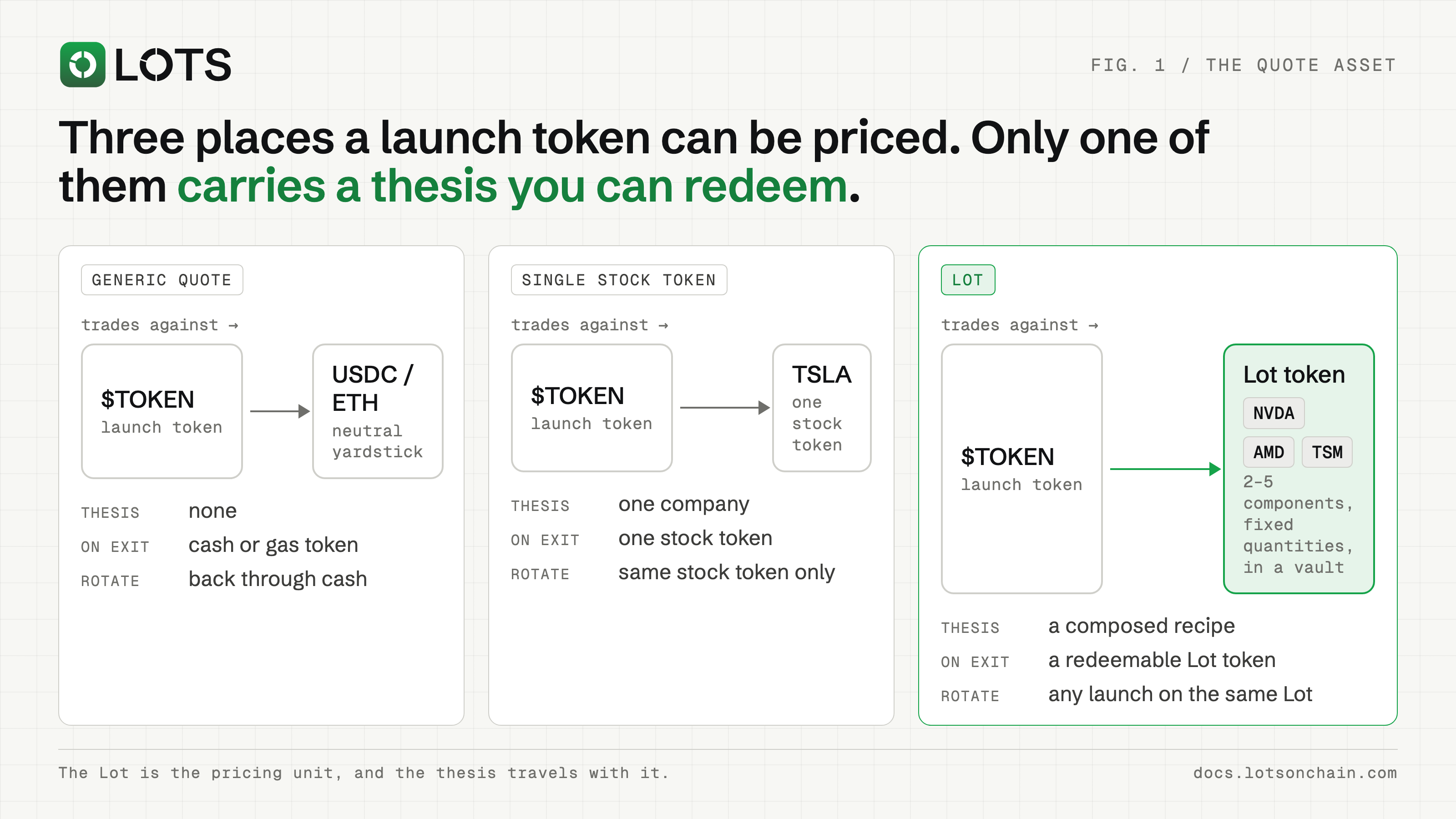
Lots takes a different approach: compose the quote asset first, then let markets form around it. The proposal is not that a themed quote improves every trade. It is that the quote’s composition can become an explicit, inspectable choice, and that several communities can reuse the same choice without duplicating its vault.
Chapter 02
Three assets, three sets of rights
The Lot holds the asset recipe. The launch token carries the narrative. $LOTS is the protocol token.
A fixed Lot consists of a vault and a redeemable ERC-20 token representing specified quantities of its component assets. The standard application composes 2–5 eligible components, matching LotFlow’s routing limit. Eligibility depends on the registry and supported routes; a token’s existence on the chain does not by itself make it an eligible component.
| Asset | What holding it provides | Normal exit |
|---|---|---|
| Fixed Lot token | A claim on the fixed component recipe, subject to rounding and successful transfers. | Redeem for component tokens, or sell through available markets. |
| Launch token | Exposure to its own speculative market. No claim on a Lot vault or launch-pool reserves. | Sell through available liquidity. |
| $LOTS | The protocol token; the intended recipient class for Lot-token rewards is its holders. | Trade through available markets. No Lot-vault redemption. |
Minting requires the complete component recipe to arrive before Lot tokens are issued. Normal redemption burns Lot tokens and returns their corresponding component quantities. A launch token paired with that Lot cannot use this redemption path: a holder must first sell into available market liquidity to obtain Lot tokens.
A Lot’s canonical identity comes from its registered recipe and vault address. An identical recipe can reuse the existing Lot. Similar names, themes or target percentages do not establish identity; different reference prices can produce different quantities from the same percentages.
Robinhood Stock Tokens provide issuer-defined economic exposure. They are tokenised debt securities, not direct legal or beneficial ownership of the referenced company shares. Packaging them in a Lot does not expand those rights. A received reward Lot has the same component-redemption rights as that particular Lot, without making either $LOTS or a launch token redeemable.
Chapter 03
From weights to a fixed recipe
Quantities are fixed at composition. Value and weights move with prices.
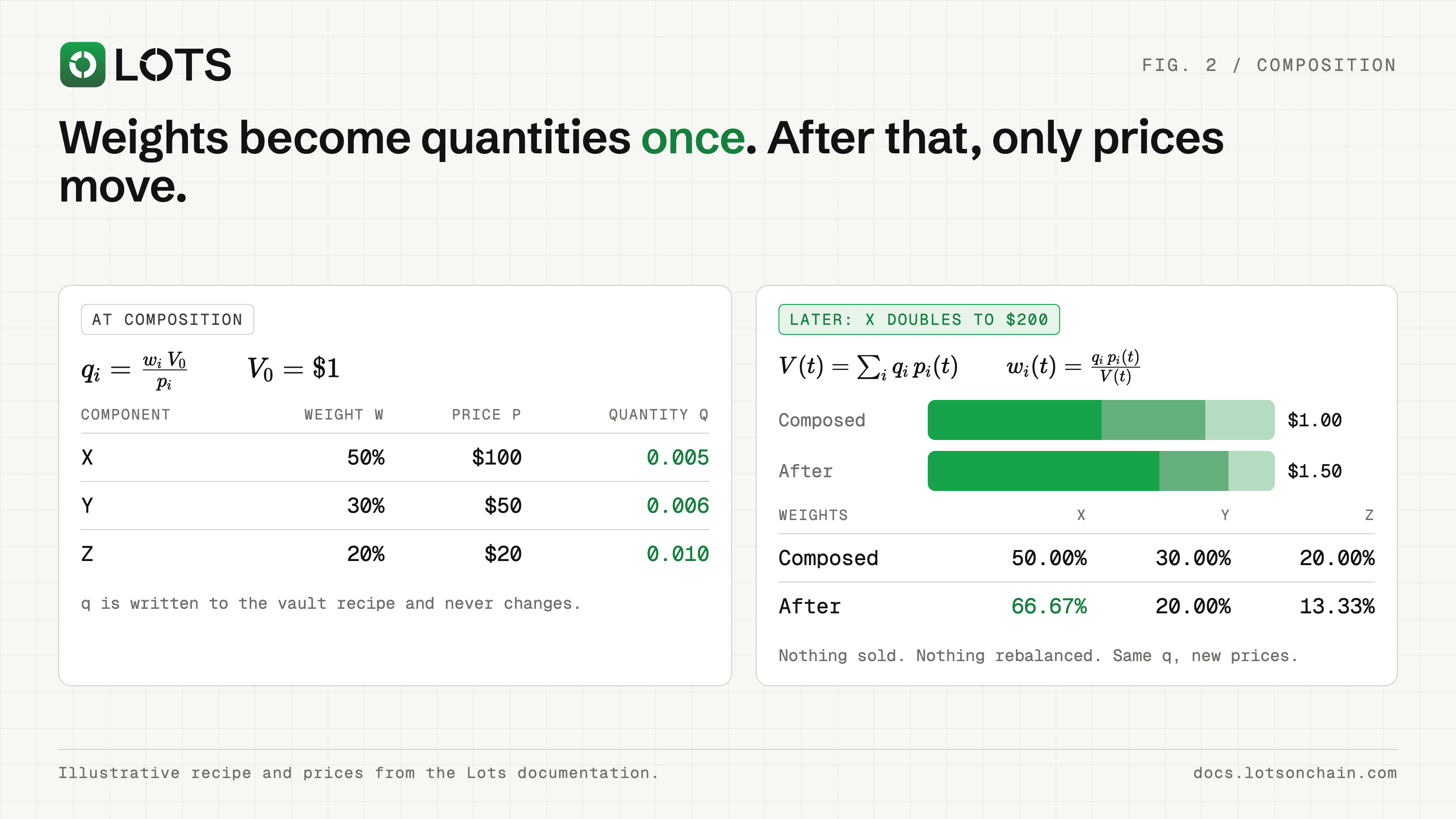
For a standard percentage-based composition, let wᵢ be component i’s target weight, pᵢ its token-denominated reference price and V₀ the initial reference value of one Lot. Weights sum to one. The composition flow targets V₀ = $1 and computes each component quantity once:
| Component | Weight | Reference price | Quantity / Lot |
|---|---|---|---|
| X | 50% | $100 | 0.005 X |
| Y | 30% | $50 | 0.006 Y |
| Z | 20% | $20 | 0.010 Z |
These fictional prices give one Lot an initial value of $1. Token precision introduces rounding; the actual onchain quantities define the recipe. Exact-quantity composition is also supported, and need not start at $1. Neither form creates a dollar peg.
If X rises to $200 while Y and Z stay unchanged, one Lot’s reference value becomes $1.50. X’s weight rises to 66.67%, Y’s becomes 20% and Z’s becomes 13.33%. No component is sold to restore the starting weights. A holder redeeming 100 Lots still receives 0.5 X, 0.6 Y and 1 Z, before any atomic-unit rounding.
V(t) is a reference valuation. A sale of the components may realise less after spreads, fees and market impact. Corporate actions can also affect a Stock Token’s economics or display multiplier while its raw token balance remains unchanged; that is distinct from a Lot rebalance.
Chapter 04
LotFlow and component liquidity
A new quote asset needs an executable route to the assets it represents.
A new Lot begins without its own trading history or deep standalone pool. Its useful starting property is the relationship between the Lot token and its components: a complete recipe can mint a Lot, and a Lot can redeem into that recipe. LotFlow uses this relationship inside a Uniswap v4 hook to create temporary liquidity for an individual swap.
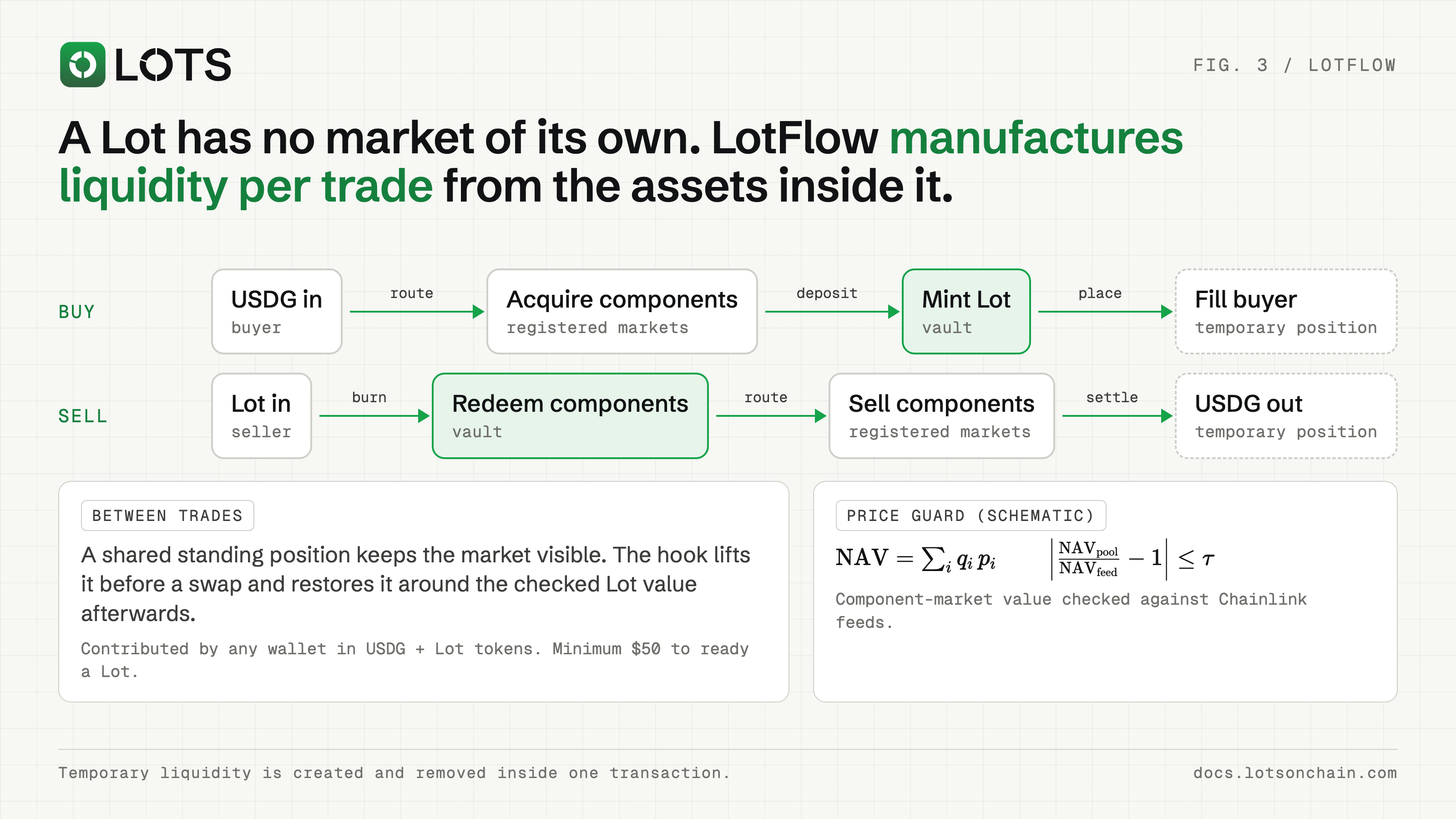
On a buy, the hook acquires the required components, mints Lot tokens and makes them available to fill the purchase. Pricing reflects component acquisition costs and a configured spread. Any unused temporary inventory is unwound before completion. On a sale, the hook supplies USDG, receives Lot tokens, redeems them and sells their components to settle.
For each component, the current hook evaluates up to three admitted USDG-paired sources and chooses a single executable source at the required size. Sources include registered hook-free Uniswap v4 pools and approved Uniswap v3 pools. This is selection among admitted venues, not a search across every market or a split across all available pools. If a required component cannot be filled, the transaction reverts.
The price guard compares the component-market valuation with configured independent Chainlink references, subject to feed coverage and configured freshness-dependent tolerances. Schematically, for checked market value Vmarket, reference value Vreference and tolerance τ:
This is a summary of a price check, not a complete specification of execution. The hook also enforces its price band and settlement conditions. The sale path ordinarily needs Lot inventory already available to the pool manager during the swap. A sale can therefore exceed settlement capacity even when the vault is fully backed. Direct vault redemption remains a separate path when the required transfers succeed.
Chapter 05
A route to the wider market
Reusable quote liquidity connects launches; each venue still has its own constraints.
LotFlow’s temporary liquidity supplies the trade. A shared standing position serves a different purpose: it keeps the Lot/USDG market visible between trades. Wallets can contribute USDG and Lot tokens, with shares accounted for by wallet and Lot. The hook removes this standing position before a swap and restores it around the checked Lot value afterwards.
The application’s preparation flow opens the Lot’s market when needed, adds at least $50 of shared liquidity and completes a small first trade. Each wallet’s first deposit has a minimum. Base and extra balances have different lock and withdrawal rules; shared deposits do not earn trading fees. Withdrawals return the position’s current asset mix, whose value may differ from the deposit. This funding is separate from vault backing and permanently locked launch principal.
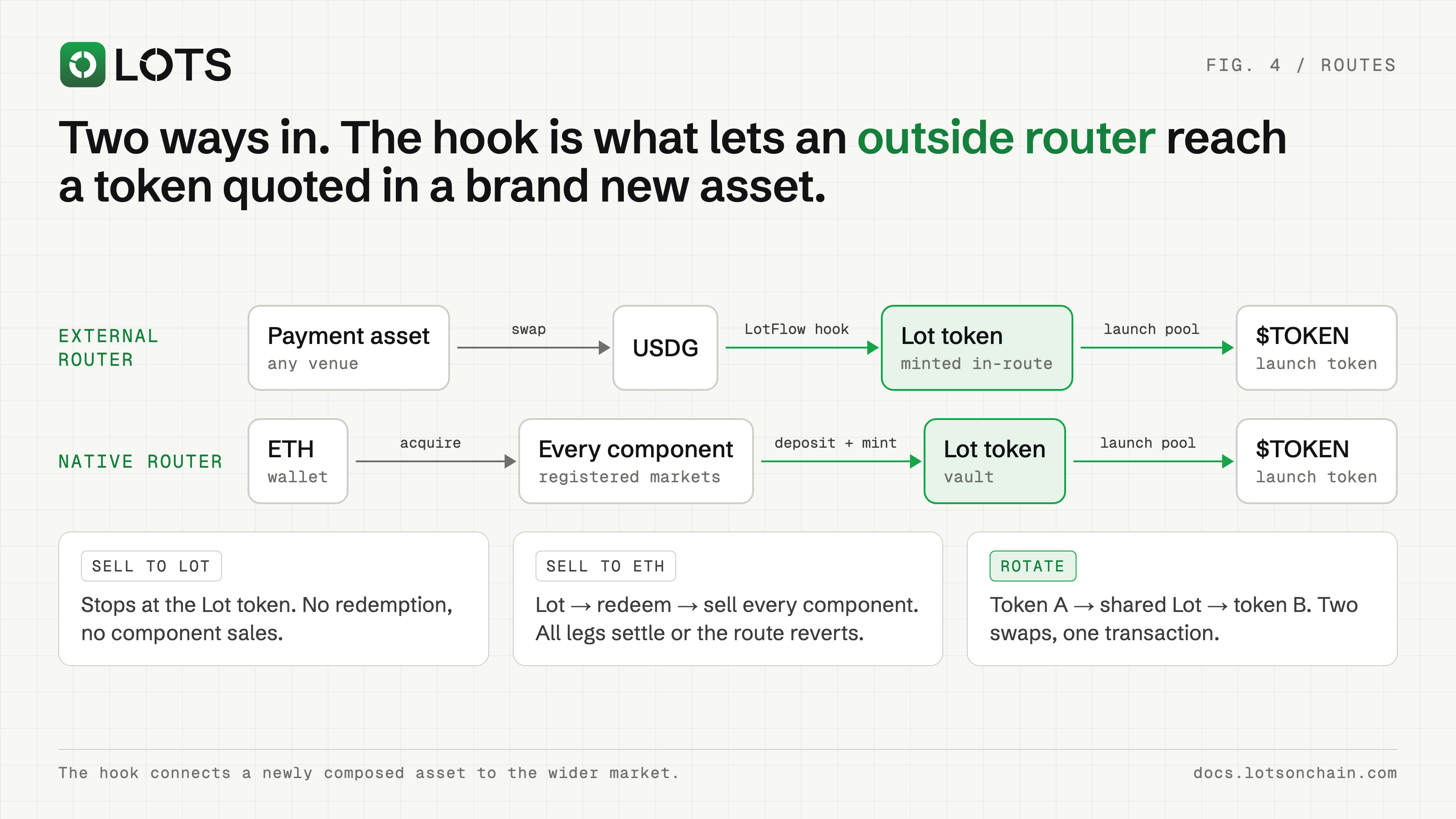
A compatible external router can use the hook for the Lot/USDG leg. Native launch trades use Lots routers and can acquire or redeem the components through their own supported paths. A route shown by one interface need not match another interface’s contracts, fees, price or maximum executable size.
A standard pool interface helps integration, but does not guarantee that a provider indexes the pool or supports its hook. Listings, charts and executable quotes are separate outcomes. Compatibility must be checked against the actual deployment; support for an earlier LotFlow hook does not establish support for its successor.
The economic advantage is reuse. Later launches can select a Lot that is already prepared and traded. They share a quote asset and its access routes while retaining distinct launch pools. This reduces duplicated quote-asset setup, but does not merge launch liquidity or remove the need for liquid components, settlement inventory and sufficient gas. Removing shared liquidity can affect outside routes for every launch using that Lot.
Chapter 06
A common launch template
Creators choose the quote and permanent trading fee within a common market structure.
| Current v1.6 launch terms | Mechanic |
|---|---|
| Issuance | One billion launch tokens, minted once; no free creator allocation or later minting. |
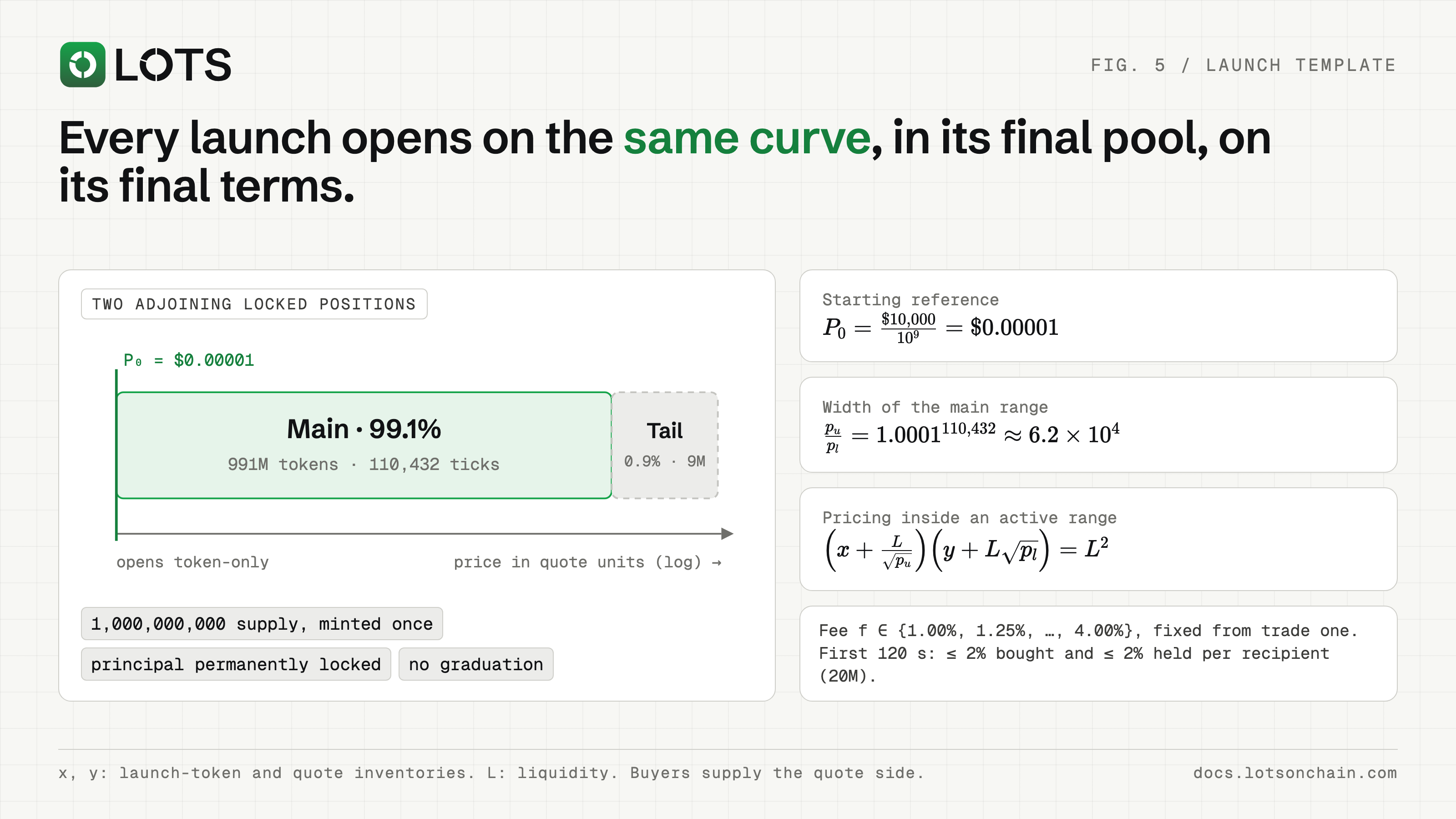
| Starting reference | $10,000 fully diluted valuation before an opening purchase; $0.00001 per original token. |
| Trading fee | Creator chooses 1–4% in 0.25% steps. The rate is permanent, with no opening surcharge. |
| Creator opening purchase | Optional paid purchase in the launch transaction, capped at 20 million tokens (2%). |
| First 120 seconds | 2% cumulative purchases and 2% post-buy balance per authenticated final recipient. |
| Launch liquidity | Two adjoining positions; principal permanently locked. No graduation or migration. |
The deployed template assigns 99.1% of issuance to the main range and 0.9% to the tail, before liquidity rounding. Both positions begin with launch tokens only. Buyers introduce the quote inventory against which later sellers trade. The initial valuation is a pricing reference, not cash deposited into the market or a resale floor.
The main range spans 110,432 ticks at a tick spacing of eight. Its price ratio is 1.0001 raised to 110,432, approximately 62,500×. The adjoining tail extends to a finite endpoint.
Within an active range, launch-token inventory x, quote inventory y and liquidity L follow the concentrated-liquidity relationship:
Here pₗ and pᵤ bound quote-per-launch-token prices. Virtual reserves in this equation are pricing terms, not extra assets available for withdrawal. Principal locking prevents discretionary removal of protected liquidity; it does not make inventory infinite or eliminate price impact.
Early limits apply per recipient, not per person. Transfers can raise a balance above the threshold and block further protected buys; multiple wallets can still accumulate positions. Creator purchases are unvested. Operations can change permitted parameters for future launches, and the recipient fee split is separately administered. Existing v1.5 launches retain their 1% trading rate.
Chapter 07
Market families and rotation
One quote asset can support many independent narratives.
Launches using the exact same registered Lot form a market family. Each has its own token, community, price, fee and liquidity inventory. Their shared asset makes it possible to move between compatible launches without dismantling the component exposure represented by that asset.
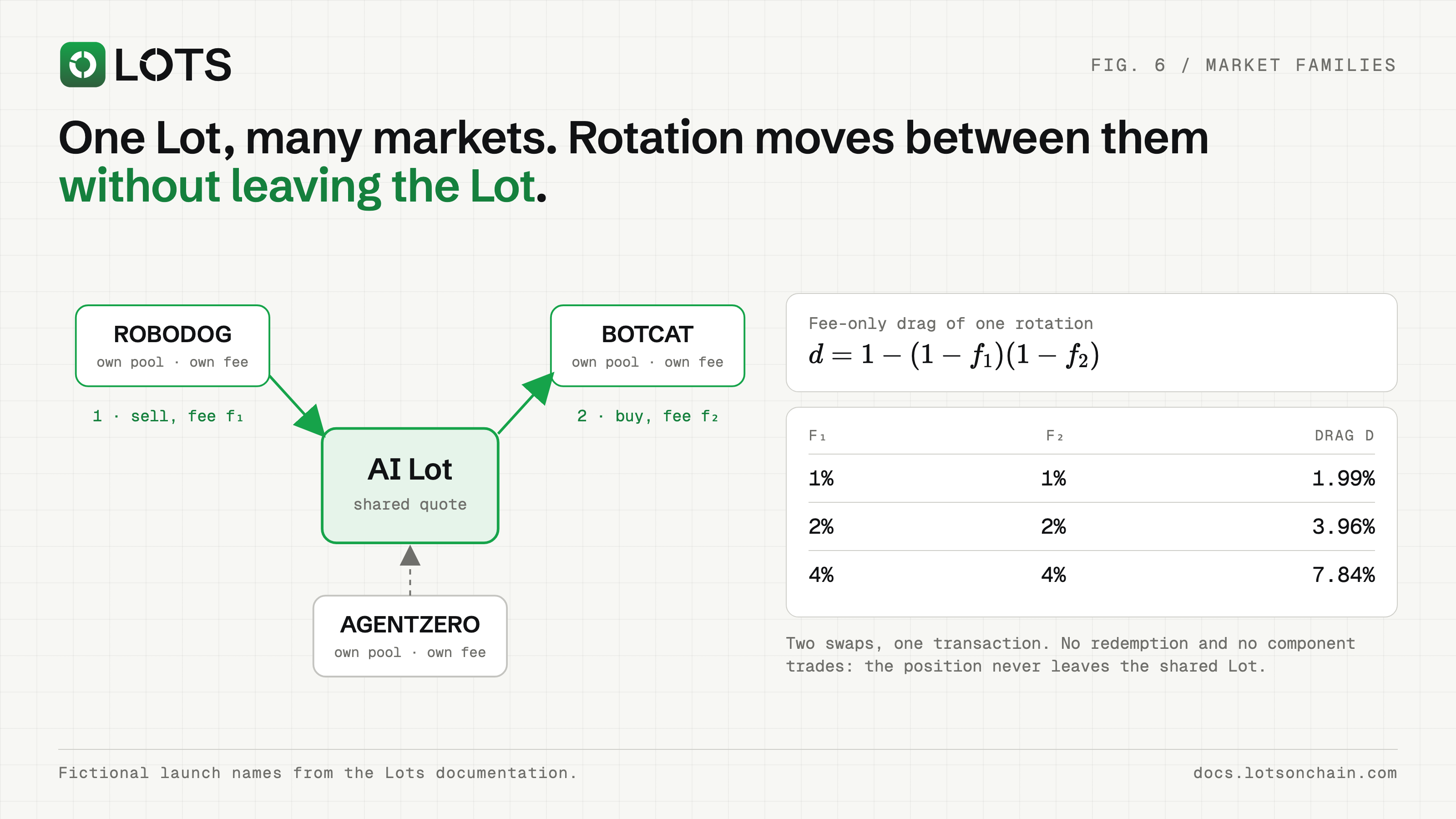
A rotation executes two swaps in one transaction: sell launch A for the Lot, then buy launch B with that Lot. Compatibility requires the same registered quote, supported factory and chain. Similar portfolio names or overlapping components are insufficient. Each swap still needs executable inventory and must satisfy the route’s bounds.
| Source fee | Destination fee | Combined fee-only drag |
|---|---|---|
| 1% | 1% | 1.99% |
| 2% | 2% | 3.96% |
| 4% | 4% | 7.84% |
These figures isolate two sequential proportional fees. They exclude price impact, gas, rounding and price movement, and are not a prediction of trading performance. Rotation saves a component-redemption and reacquisition path; it does not remove either launch pool’s fee.
The network can consequently accumulate a library of reusable quote assets rather than a separate asset wrapper for every launch. That is a possible source of lower setup friction and connected demand. It also concentrates dependencies: problems in a shared Lot’s components or access routes can affect several otherwise independent markets at once.
Chapter 08
Fees, project earnings and network rewards
Follow the currency of each fee before describing where its value goes.
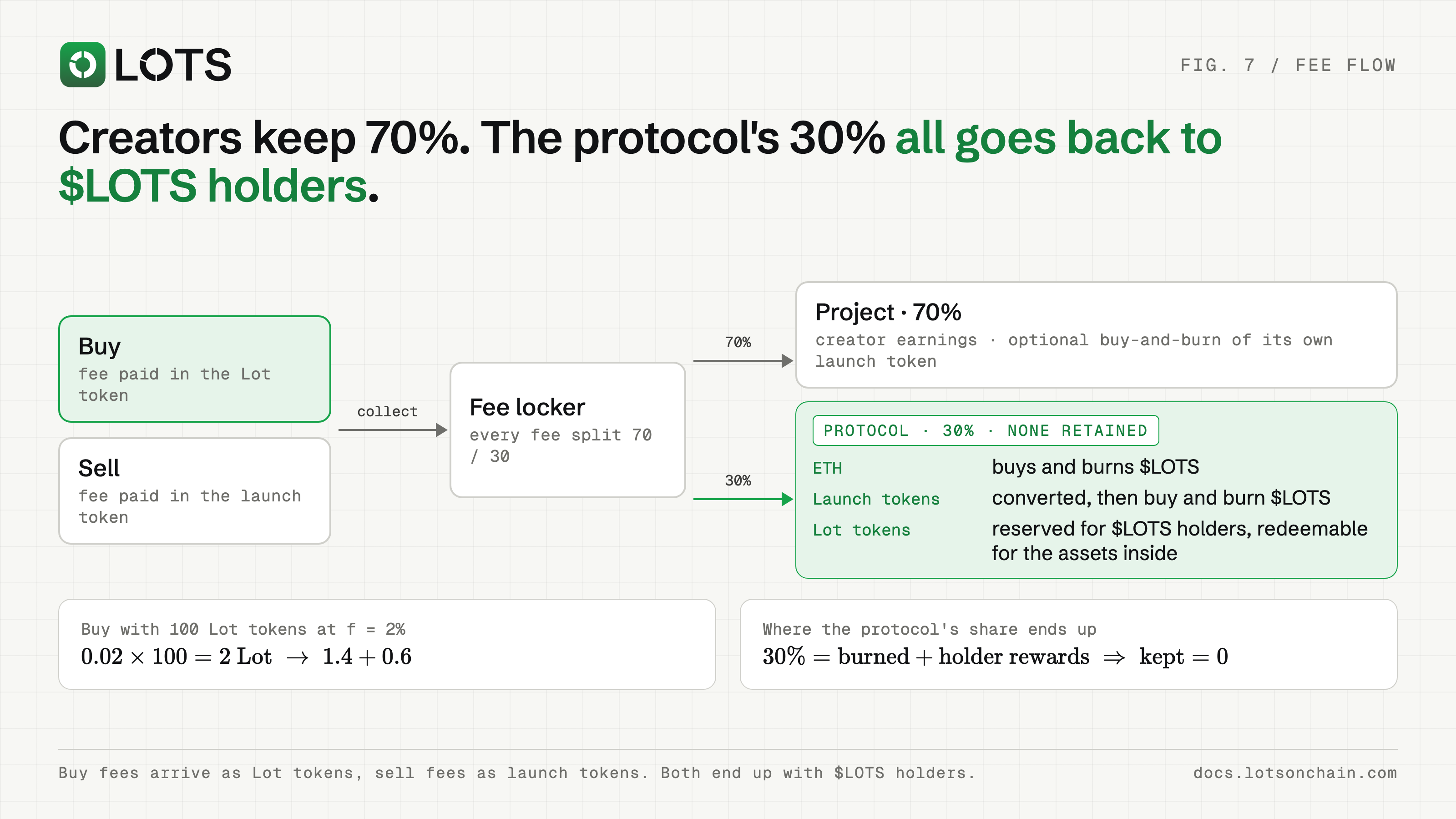
The documented allocation is 70% of launch trading fees to the project and 30% to the protocol, with no separate Lot-creator share. These are shares of fees, not shares of the trade’s full value. The locker accounts in the tokens actually collected. A buy of a Lot-paired launch pays its pool fee in Lot tokens; a sale pays in the launch token. Funding a route with ETH does not turn its launch-pool fees into ETH.
| Illustrative trade at 2% | Total fee | Project (70%) | Protocol (30%) |
|---|---|---|---|
| Buy with 100 Lots | 2 Lots | 1.4 Lots | 0.6 Lots |
| Sell 1,000 launch tokens | 20 launch tokens | 14 launch tokens | 6 launch tokens |
A project may commit 0–100% of its future fee earnings to its own token’s buybacks and burns. Committed quote assets buy the launch token through its approved pool and burn the purchase atomically. Committed launch-token fees can be burned directly. Execution is conditional on funding, price bounds, limits and gas; setting an allocation is not proof that a buyback has executed.
Protocol launch-token receipts remain separate balances until a conversion actually occurs. Collection itself performs no conversion into ETH or $LOTS. The paper therefore does not treat the entire protocol share as an already executed return to holders. Distribution mechanics and timing remain unpublished, and no individual reward rate is specified.
The proposition is the reward asset: a distributed Lot represents redeemable component quantities, funded by fee receipts rather than new Lot issuance without backing. If the reserve receives 12 Lot A and 8 Lot B, those are two distinct balances. A Lot with no receipts contributes nothing. Neither the reserve nor buybacks may be confused with vault backing or locked launch principal.
The permanent trading rate and the recipient split are different controls. The locker allows future collection shares to change within its treasury cap. Rewards remain contingent on implementation and actual receipts; burns create no guaranteed price support.
Chapter 09
Measure the trade in both units
The launch performance and the quote-asset performance multiply.
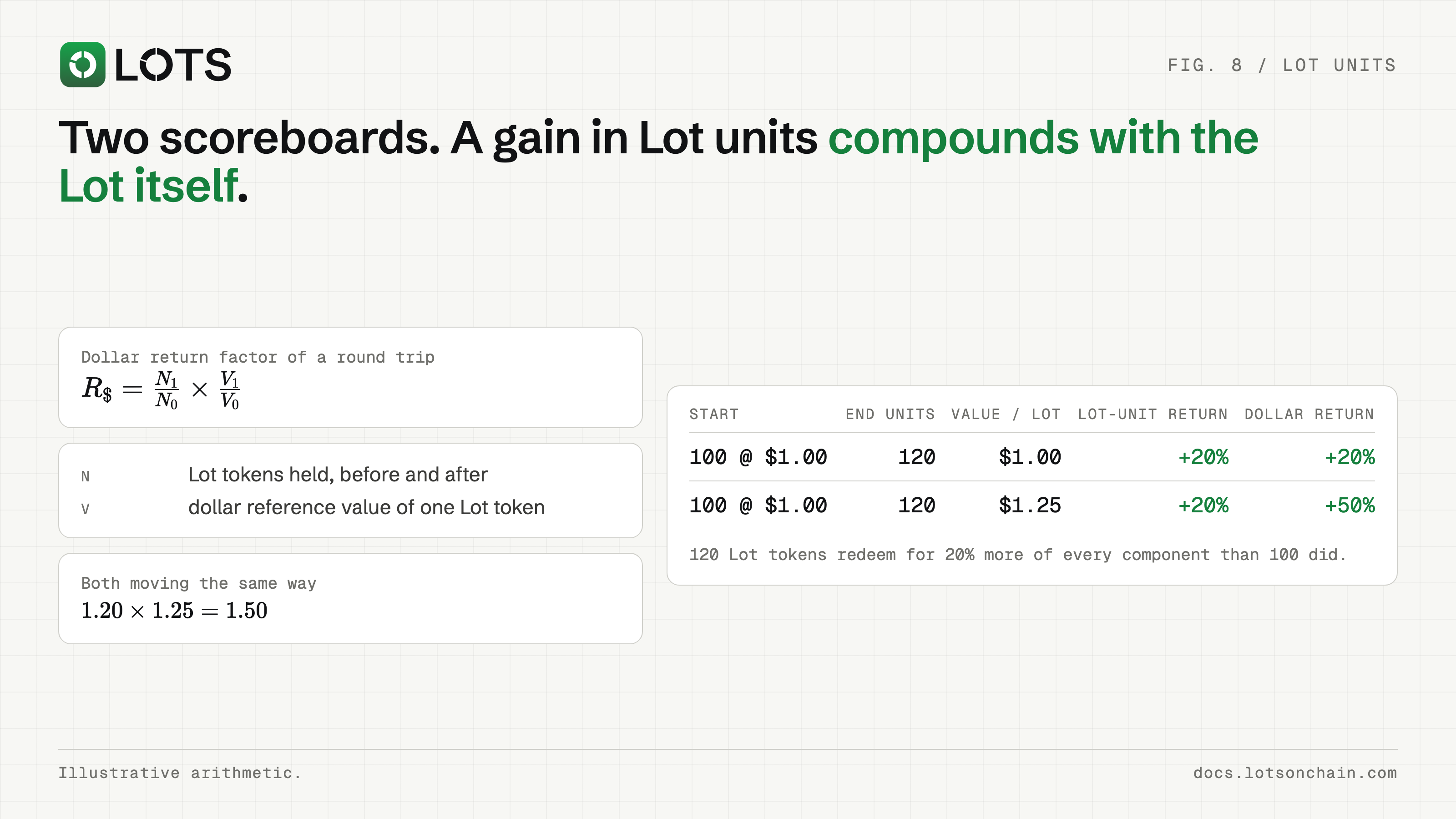
Suppose a round trip starts with N₀ Lots and finishes with N₁ Lots. Let V₀ and V₁ be their per-Lot dollar reference values at the two times. With no intermediate deposits or withdrawals, define the Lot-unit gross multiple Mlot and dollar gross multiple MUSD:
Separating a gross multiple from a percentage return avoids an easy ambiguity: 1.50× means a 50% gain. The following scenarios all start with 100 Lots worth $1 each and use fictional endpoint prices:
| Lots at exit | Value per Lot | Lot return | Dollar return |
|---|---|---|---|
| 120 | $1.25 | +20% | +50% |
| 120 | $0.75 | +20% | −10% |
| 80 | $1.25 | −20% | 0% |
| 80 | $0.75 | −20% | −40% |
In the first scenario, 20% more Lots and a 25% rise in the Lot value produce 1.20 × 1.25 = 1.50. In the second, the same successful Lot-unit trade still loses dollars. The fourth shows the two exposures working against the holder together.
N₁ should represent the Lots actually received after trading costs. If N₁ is instead a hypothetical pre-fee amount, fees and impact must be deducted separately. Gas paid outside the Lot balance and any later sale of the Lots or components are additional costs. Dollar figures here mark the position at reference values; they do not promise liquidation proceeds.
Chapter 10
Current architecture and extensions
A fixed recipe and a managed portfolio are different products.
| Area | Status at this edition |
|---|---|
| Fixed Lots, minting and redemption | Implemented; eligible components and successful transfers required. |
| Launch, trade and rotate | Implemented through supported routes; application and API access restricted. |
| LotFlow and shared liquidity | Implemented for eligible Lots on supported deployments; execution remains conditional. |
| Project fee claims and buybacks | Implemented; collections remain in their received currencies and execution is bounded. |
| Protocol $LOTS buybacks and distributions | Upcoming. Allocation described; no distribution schedule published. |
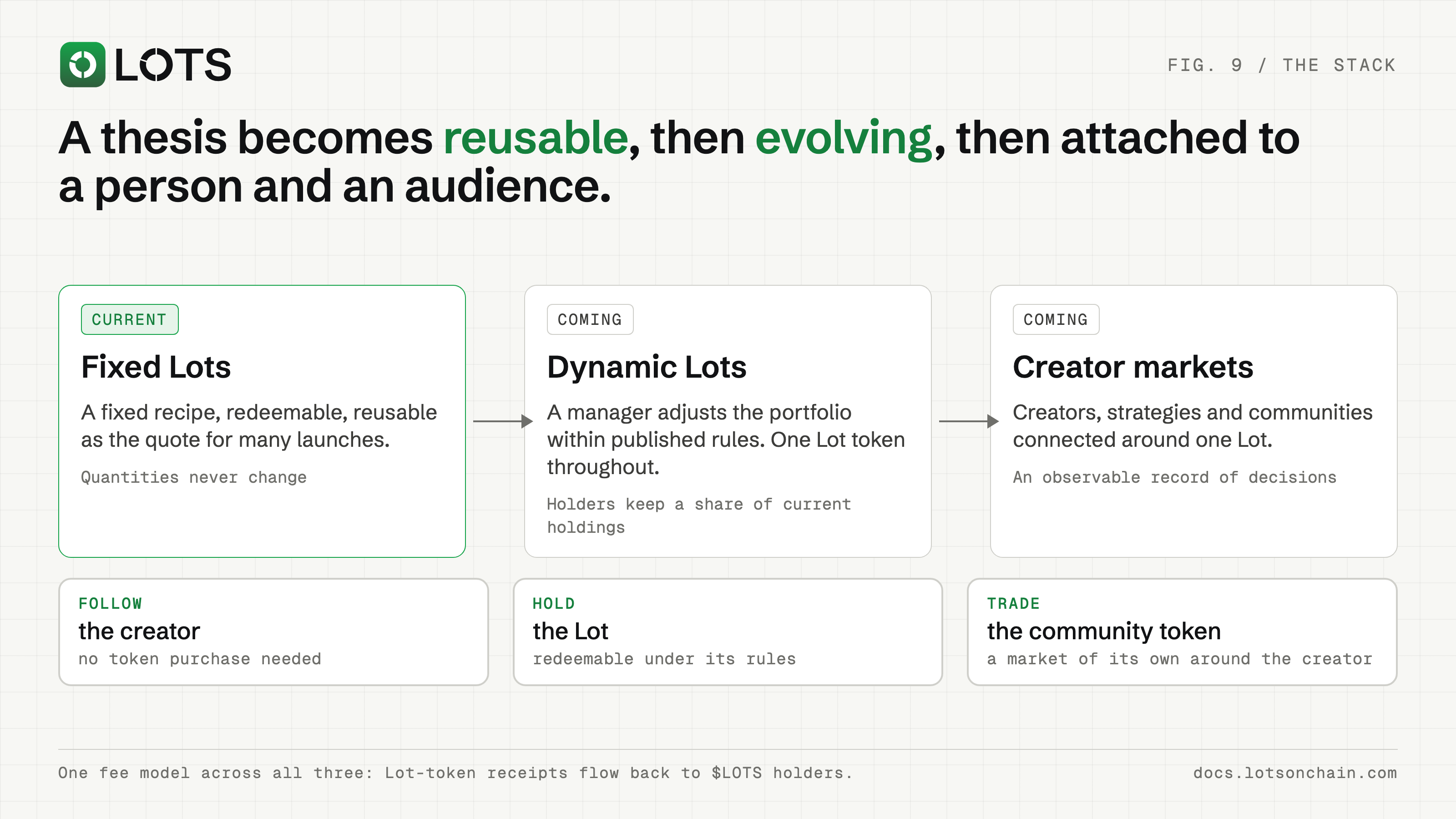
| Dynamic Lots and SocialFi creator markets | Upcoming products; not capabilities of an existing fixed Lot. |
Dynamic Lots would let a manager change holdings within published rules while one token represents a proportional share of the current portfolio. This can keep a community’s quote identity consistent as its strategy evolves. It adds management decisions, mandate enforcement and trading costs. Existing fixed Lots retain their original recipes.
SocialFi creator markets would connect a creator’s observable strategy with an audience and related community markets. Following a creator, holding a strategy Lot and trading a community token are distinct actions. Following requires no purchase; a community token grants no automatic ownership of the creator, their income or the strategy’s assets.
The intended network-rewards allocation can include eligible Dynamic Lot receipts, but both that product and holder distributions remain upcoming. This paper specifies neither a release date nor token supply, emission schedule or individual reward entitlement.
The underlying vault can accept up to ten components, while the current composer and LotFlow support two to five. A larger directly created vault does not gain a compatible market automatically. Similarly, a separate deployment for ETH-priced components does not imply that application composition or launch-quote support is available for those Lots. Product boundaries must follow the actual route and version.
Chapter 11
Dependencies, controls and limits
Backing, a liquidity lock and a price check address different problems.
Market risk. Both the launch token and its quote asset can fall in value, potentially to zero. A fixed recipe can concentrate in correlated exposures as weights drift. Locked principal, a starting valuation, a token burn or a reference NAV creates no price floor and no guarantee of exit liquidity.
Execution risk. LotFlow depends on complete component fills, valid price checks, sufficient settlement inventory and transaction gas. A route can revert or become unavailable. A deep-looking aggregate valuation does not establish capacity in each component at the requested size. Shared standing liquidity, vault backing and launch-pool liquidity must be evaluated separately.
Asset and issuer risk. The component tokens retain their issuer-defined rights and restrictions. Transfer controls, impaired assets, corporate actions and issuer failures can affect minting, redemption and sale routes. USDG and any other payment or reference assets introduce their own dependencies. Wrapping assets does not remove them.
Contract and infrastructure risk. Bugs, economic exploits, compromised approvals or keys, incorrect integration, stale data and chain outages can cause loss. A Uniswap or other dependency audit is not an audit of Lots. No independent Lots audit is published in the product-status documentation at this edition’s cutoff.
Administrative risk. A 2-of-3 owner Safe administers registries, routes, certain controls and future-launch parameters without a mandatory timelock. The locker permits recipient-share changes for future collections within a 50% treasury cap. Fixed recipes, existing permanent trading rates and protected launch principal have separate constraints. There is no discretionary official-pool trading pause, including during an exploit, which limits emergency containment.
Access and recovery. The application and API remain restricted to authorised users, and eligibility also depends on location and assets. Technical access is not permission to bypass restrictions. Recovery provisions do not insure losses or promise an amount or deadline, and there is no public recovery interface. A launch token alone grants no Lot recovery claim.
This paper explains a product architecture. It is not investment, legal or tax advice, an offer where unlawful, or a replacement for applicable terms and issuer documents. Readers should verify the exact chain, vault, pool, contract version and executable quote for any contemplated action.
Chapter 12
Compose the assets. Launch the narrative.
The contribution is a reusable quote layer for independent markets.
Lots treats the quote side of a trading pair as part of the product. A fixed Lot turns an asset thesis into a named, inspectable and redeemable unit. A launch token creates a separate market against it. Compatible launches can reuse that unit and rotate through it without redeeming the underlying recipe.
LotFlow connects this model to existing component liquidity. It does not create capital from nothing: it uses acquisition, minting, redemption and settlement to supply liquidity when a trade can be executed. That dependency is the mechanism’s strength and its limit. A useful quote asset needs both a clear redemption relationship and routes that work at the size being traded.
The fee model adds a proposed connection across market families. Project earnings already follow their own pools. The protocol’s Lot-token reward allocation would let activity across contributing markets reach $LOTS holders as redeemable assets. That economic intent is distinct from the distribution system still to be delivered.
The resulting design can be assessed through concrete questions: Is the recipe fully funded? Are its quantities and rights clear? Can the route execute? Which currency pays the fee? What can an operator change? Which features are available now? Those questions make the thesis testable without relying on a token theme or a projected return.